
Vibe Coding: From Line Cook to Head Chef
Main Source: Vibe Coding: Building Production-Grade Software With GenAI, Chat, Agents, and Beyond
Vibe Coding isn’t just a productivity hack to increase the number of lines we can sling; it’s a foundational reimagining of what it means to be a software engineer. It opens up the economic possibilities of what can be built, and expands the system scope of what one person can attempt; shifting the engineer’s role from “line cook” to “head chef.”
No longer will we be specialists exclusively; instead, we’ll specialize and gain new perspective by using that specialization as we explore the full-stack implementation of our ideas.
FAAFO
- Fast
- Ambitious
- Autonomous
- Fun
- Optionality
The Future is Here
With an LLM, we can have sophisticated, intellectual discussions, debate approaches, and solve complex problems through natural conversation. … Steve spent decades being a tech skeptic and a late adopter, and Gene spent decades researching questionable claims of practices that supposedly improved software productivity. But the evidence changed our minds… (Kim and Yegge 5)
The first part of this book is dedicated to explaining why the reader should take vibe coding seriously, with countless examples of what’s been accomplished, both for Kim and Yegge; but they also quote several others who are well accomplished in the industry. For the sake of brevity, I’ll highlight a few and summarize it this way:
Vibe Coding is not a fad, nor a toy, nor a tool only meant for prototypes.
It’s a foundational change in the ability to amplify the engineer’s capabilities, provided they think clearly, systematically, and with clear purpose. Just as the IDE made programming easier, so too has agentic coding. The typing of functions may be gone, but the engineering principles of software development didn’t go anywhere. If anything, they’re more relevant now than ever, when every developer suddenly can ship 10,000 lines a day.
“There’s a new kind of coding I call ‘vibe coding,’ where you fully give in to the vibes, embrace exponentials, and forget that the code even exists,” - Karpathy (Kim and Yegge 6)
Garry Tan, CEO of Y Combinator, Silicon Valley’s most famous startup incubator, said, “For 25% of the Winter 2025 batch, 95% of lines of code are LLM generated…The age of vibe coding is here.” (Kim and Yegge 7)
Sergey Brin, Google cofounder … “The role of the engineer will change more to being the product engineer, where they decide what the product should do,” (Kim and Yegge 8)
Vibe Coding for Grown-Ups
That means all the grown-up stuff that you may already be responsible for: security reviews, test coverage, blast radius management, and operational excellence. The difference is that you’re doing this at speeds none of us have ever experienced before—you know, creating thousands (potentially tens of thousands) of lines of code per day. (Kim and Yegge 8)
This is the real point, and what I think worries most software engineers.
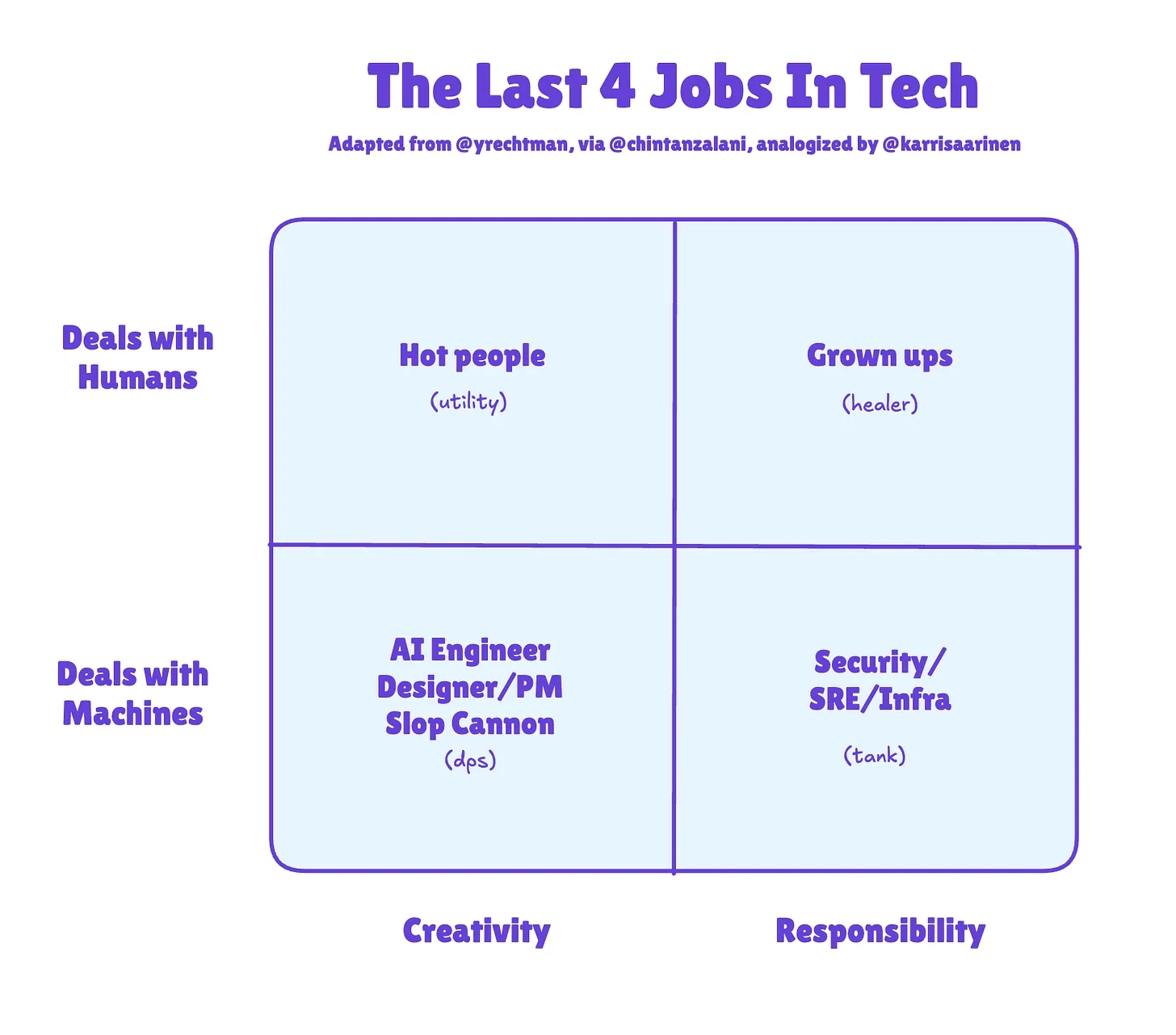
Derived from this tweet
DPS, tank, utility, healer
The idea that programmers would turn into “Slop Cannons.”
Fear not. The whole point of this book is to embrace frameworks that will transform agentic coding from a slot machine of rapid code to a well-structured orchestration of feature development that passes more rigorous testing and follows strict design paradigms.
However, here’s one thing we genuinely believe: No one should be writing code by hand anymore if they don’t have to. (Kim and Yegge 8)
Programming: No Winners, Only Survivors
Programming languages evolved to let us express ideas more naturally, focusing on high-level problems rather than computer internals. (Kim and Yegge 17)
I can’t speak directly to this evolution, as I’ve not been an engineer long enough to see languages evolve that much; but I do recall, in high school, being forced to write Java in Notepad++ and then, six weeks later, being allowed to upgrade to Dreamweaver and thinking I’d just found the secret weapon to productivity.
But let me tell you, that jump to an IDE is nothing compared to mastering agentic coding.
Debugging and testing are still painful. (Kim and Yegge 18)
There is no shortcut here. And this, and only this, is the reason I’d advise anyone not yet in the industry to still code by hand as much as possible. It’ll pay off in the long run. At the very least, practice small projects by hand.
Although we find vibe coding to be far better than the old way (because of FAAFO benefits), that doesn’t mean vibe coding is easy. (Kim and Yegge 19)
It’s another skill that must be stacked upon the hundreds before it. What’s more, it’ll rapidly expose your weaknesses. However, this is a blessing, and why programming becomes more addictive than video games. You’ll get instant feedback, and the opportunity to improve by more than 1% per day (assuming you’re around my level).
As Astronaut Frank Borman once said, “Superior pilots use their superior judgment to avoid situations which require the use of their superior skill.” (Kim and Yegge 20)
Some will mourn the loss of certain technical challenges (we still meet graphics engineers nostalgic for texture mapping in assembly), but most will celebrate when they realize what’s possible. (Kim and Yegge 22)
The Value Vibe Coding Brings
It can take both vigilance and good judgment to recognize when you’re being led down a rabbit hole and need to change course. Vibe coders must learn to notice when AI is heading confidently down a wrong path and decide when to redirect or abandon unproductive approaches. (Kim and Yegge 24)
Teamwork has never been more important. We must all embrace a large glass of humility and chug it like a man lost in a desert. We’ve found ourselves in the dark forest, and while we can all see our own small grove, none of us knows where the forest boundaries are, and we must pool our resources and knowledge together to find the path. Together we will find the Cumberland Gap.
As Cat Wu, product manager of Anthropic’s Claude Code team, observed: “Sometimes customer support will post ‘Hey, this app has this bug’ and then 10 minutes later one of the engineers will be like ‘Claude Code made a fix for it.’ Without Claude Code, I probably wouldn’t have done that… It would have just ended up in this long backlog.” There has always been a category of work where it was easier to fix than to record and prioritize. That category is bigger now with AI. (Kim and Yegge 25)
I’ve gotten into the habit of logging my day as bullet points in Obsidian, and then at the end of the week shipping that to my executive summary agent, who turns it into a digestible report for upper management. I only log feature ships in Jira. I stopped making subtasks, unless I’m planning something out there. We move too fast to track everything there, when our GitHub PRs are the tracking.
Give small, cross-functional teams complete ownership of their problem space with full capability to deploy solutions without navigating layers of dependencies and approvals. (Kim and Yegge 26)
I’m a huge sports follower, but I played basketball as a child, and my coach called it zone defense. We all had our section, and each bubble overlaps just enough for the handoff. We need zone defense within our codebases. Not just for our human contributors, but for our new silicon teammates.
Beyond eliminating organizational friction, AI also helps solve an equally difficult problem: the “mind reading” tax inherent in collaboration. (Kim and Yegge 26)
Scott Belsky, Chief Product Officer at Adobe, describes this as “collapsing the stack,” illustrating the benefits of the same person owning more of the process. (Kim and Yegge 28)
Fernando Cornago, SVP of Digital Technology at Adidas, described how vibe coding resulted in developers spending 50% more time in what they called “Happy Time,” productive time when they were mastering their craft. This is the opposite of “Annoying Time,” such as struggling with brittle tests and meetings. (Kim and Yegge 28)
Call me crazy, but I for one like my meetings; though from what I’ve heard from my peers, I’m already in a lucky place where my meeting time is <20% of my week (even counting messages).
Vibe coding increases your ability to explore options and mitigate risks before committing to decisions. (Kim and Yegge 29)
Knowing that I can branch twice and let the agents work on two different designs, and then come back and stress-test both solutions, is pure gold.
Have I mentioned the beauty of tmux? (DevOps Toolbox offers a great tutorial: Tmux From Scratch To BEAST MODE and a tmux Cheat Sheet)
FAAFO
- Fast feedback loops and high velocity make more projects feasible
- Ambition reshapes your project landscape
- Autonomy eliminates friction
- Fun drives engagement
- Options create competitive advantage